History of Pompeii
The origins of Pompeii date back to the 6th century BC, involving Oscan, Greek, and Etruscan groups. The city was subsequently conquered by the Samnites before falling under Roman domination. In 89 BC, Lucius Cornelius Sulla settled nearly 2 000 veterans there, accelerating its rapid Latinization.
The city prospered in Campania, the land of the gods renowned for its fertility. However, a powerful earthquake in 62 AD severely damaged the baths and water network. These damages were still visible during the final catastrophe that sealed the city's fate a few years later.
Buried under meters of volcanic sediment, Pompeii paradoxically escaped medieval looting. It fell into 15 centuries of oblivion, mentioned only by Statius and Martial. It was not until the 17th century, after traces found in 1592, that real rediscovery began.
What to see in Pompeii
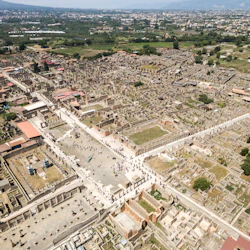
The political and religious heart is located at the Forum, the central point essential for orientation. Around this square, discover the Basilica and major temples. These structures offer immediate insight into the urban and social organization of the ancient Roman city.
The Villa of the Mysteries impresses with its colorful frescoes, better preserved than the exterior structures. This site testifies to the artistic wealth and initiatory rites practiced locally. Photographing these works allows you to grasp the cultural vitality that animated wealthy private residences.
The Large Theatre and the Stabian Baths illustrate public life and daily leisure. These spaces hosted spectacles and baths, essential for social cohesion. Visiting these sites offers a pragmatic immersion into the habits of citizens before the volcanic tragedy of 79 AD. Preserved wall frescoes still testify to the cultural importance accorded to performing arts by this prosperous Italic community.
Practical tips for visiting Pompeii
For a practical guide to visiting Pompeii, prefer the months of March-April or September-October. These periods avoid extreme heat and dense summer crowds. Pompeii opening hours 2024 vary: 9am-7pm in high season and 9am-5pm in low season.
Bring closed walking shoes as the ground is uneven and paved with ancient debris. Plan also for sunscreen, a cap, and a refillable water bottle at free fountains. A light picnic is advised, as only one snack exists near the Forum.
The difference between the Pompeii Herculaneum ticket lies in the size and density of the sites. Combine them if you are organized, but Herculaneum requires less time. Also consider checking accessibility for people with reduced mobility, as the terrain is difficult.